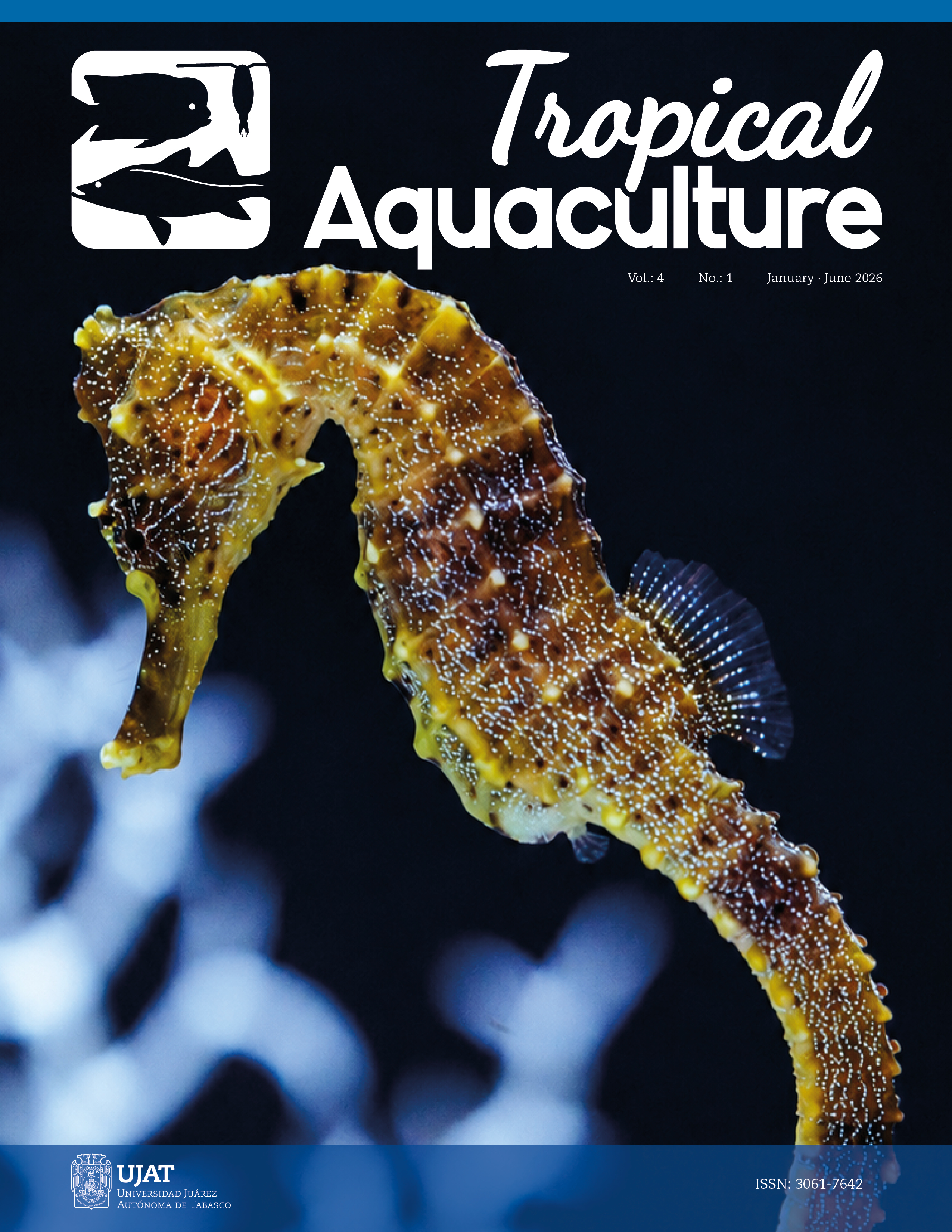
The Seahorse (Hippocampus spp.) as a Model for Tropical Aquaculture with a Conservation Approach
DOI:
https://doi.org/10.19136/ta.a4n1.5760Keywords:
Hippocampus sppAbstract
Aquaculture in tropical regions has historically been promoted under frameworks oriented toward economic profitability, while biodiversity conservation has been treated as a separate sphere from the productive use of natural resources. This dichotomy is particularly problematic in tropical coastal-estuarine contexts, where the well-being of human communities and the integrity of ecosystems are closely interconnected. This paper proposes Hippocampus spp. as a model for conservation-oriented tropical aquaculture, not aimed at industrial production, but at the use of cultivation as a tool for conservation, environmental education, and the generation of diversified social and economic benefits. The model is structured around three core components: (i) Hippocampus spp. as a flagship species and an articulating organism linking biodiversity, knowledge, and territory; (ii) a tripartite governance framework based on the functional articulation among organized communities, academic institutions, and the State; and (iii) a logic of multiple benefit flows, in which ecological, social, and indirect economic returns are prioritized over the maximization of production volumes. The cultivation of Hippocampus spp. is highlighted as a socioecological sustainability model in the face of the socioenvironmental crisis, integrating conservation, responsible use of biodiversity, and territorial well-being in tropical contexts, based on a conceptual and synthetic review of the specialized scientific literature
Downloads
References
Berkes, F. (2009). Evolution of co management: Role of knowledge generation, bridging organizations and social learning. Journal of Environmental Management, 90(5), 1692–1702. https://doi.org/10.1016/j.jenvman.2008.12.001 DOI: https://doi.org/10.1016/j.jenvman.2008.12.001
Berkes, F., Colding, J., & Folke, C. (2003). Navigating social ecological systems: Building resilience for complexity and change. Cambridge University Press.
Cohen, F. P., Valenti, W. C., Planas, M., & Calado, R. (2017). Seahorse aquaculture, biology and conservation: knowledge gaps and research opportunities. Reviews in Fisheries Science & Aquaculture, 25(1), 100-111. https://doi.org/10.1080/23308249.2016.1237469 DOI: https://doi.org/10.1080/23308249.2016.1237469
Food and Agriculture Organization of the United Nations (FAO). (2015). Voluntary Guidelines for Securing Sustainable Small Scale Fisheries in the Context of Food Security and Poverty Eradication. FAO.
Food and Agriculture Organization of the United Nations (FAO). (2020). The State of World Fisheries and Aquaculture 2020. FAO.
https://doi.org/10.4060/ca9229en DOI: https://doi.org/10.4060/ca9229en
Folke, C., Hahn, T., Olsson, P., & Norberg, J. (2005). Adaptive governance of social ecological systems. Annual Review of Environment and Resources, 30, 441–473. https://doi.org/10.1146/annurev.energy.30.050504.144511 DOI: https://doi.org/10.1146/annurev.energy.30.050504.144511
Folke, C., Biggs, R., Norström, A. V., Reyers, B., & Rockström, J. (2016). Social ecological resilience and biosphere based sustainability science. Ecology and Society, 21(3), 41. https://doi.org/10.5751/ES-08748-210341 DOI: https://doi.org/10.5751/ES-08748-210341
Foster, S. J., & Vincent, A. C. J. (2004). Life history and ecology of seahorses: Implications for conservation and management. Journal of Fish Biology, 65(1), 1–61. https://doi.org/10.1111/j.0022-1112.2004.00429.x DOI: https://doi.org/10.1111/j.0022-1112.2004.00429.x
Koldewey, H. J., & Martin Smith, K. M. (2010). A global review of seahorse aquaculture. Aquaculture, 302(3–4), 131–152. https://doi.org/10.1016/j.aquaculture.2009.11.010 DOI: https://doi.org/10.1016/j.aquaculture.2009.11.010
Naciones Unidas. (2015). Transforming our world: The 2030 Agenda for Sustainable Development. United Nations.
Nájera Medellín, J. A., Quiñónez Martínez, M., Díaz Gaxiola, J. M., Santos Fita, D., Narchi, N. E., & Corral Avitia, A. Y. (2023). Especies de caballito de mar (Syngnathidae, Hippocampus) de México: estado de conservación y oportunidades futuras. Revista de Biología Marina y Oceanografía, 58(2), 67–84. https://doi.org/10.22370/rbmo.2023.58.2.4209 DOI: https://doi.org/10.22370/rbmo.2023.58.2.4209
Pauly, D. (1997). Small-scale fisheries in the tropics: marginality, marginalization, and some implications for fisheries management. Global trends: fisheries management, 20, 40-49.
Salafsky, N., Margoluis, R., Redford, K. H., & Robinson, J. G. (2001). Adaptive management: A tool for conservation practitioners. Biodiversity Support Program.
Shokri, M. R., Gladstone, W., & Jelbart, J. (2009). The effectiveness of seahorses and pipefish as a flagship group for the conservation of estuarine habitats. Aquatic Conservation: Marine and Freshwater Ecosystems, 19(5), 588–595. https://doi.org/10.1002/aqc.1009 DOI: https://doi.org/10.1002/aqc.1009
Verissimo, D., MacMillan, D.C. and Smith, R.J. (2011), Toward a systematic approach for identifying conservation flagships. Conservation Letters, 4: 1-8. https://doi.org/10.1111/j.1755-263X.2010.00151.x DOI: https://doi.org/10.1111/j.1755-263X.2010.00151.x
Vincent, A. C. J., Sadovy de Mitcheson, Y., Fowler, S. L., & Lieberman, S. (2014). The role of CITES in the conservation of marine fish species. Fish and Fisheries, 15(4), 563–592. https://doi.org/10.1111/faf.12035 DOI: https://doi.org/10.1111/faf.12035
Vite-Garcia, N., Simoes, N., Arjona, O., Mascaro, M., & Palacios, E. (2014). Growth and survival of Hippocampus erectus (Perry, 1810) juveniles fed on Artemia with different HUFA levels. Latin American Journal of Aquatic Research, 42(1), 150-159. https://doi.org/10.3856/vol42-issue1-fulltext-12 DOI: https://doi.org/10.3856/vol42-issue1-fulltext-12
Vite García, N., López Jiménez, S., & Rangel López, L. (2017). Avances en el cultivo de Hippocampus spp. (Teleostei: Syngnathidae): investigaciones en el siglo XXI. Latin American Journal of Aquatic Research, 45(1), 1–17. https://doi.org/10.3856/vol45-issue1-fulltext-1 DOI: https://doi.org/10.3856/vol45-issue1-fulltext-1
Downloads
Published
Issue
Section
License
Copyright (c) 2026 Tropical Aquaculture

This work is licensed under a Creative Commons Attribution-NonCommercial-NoDerivatives 4.0 International License.